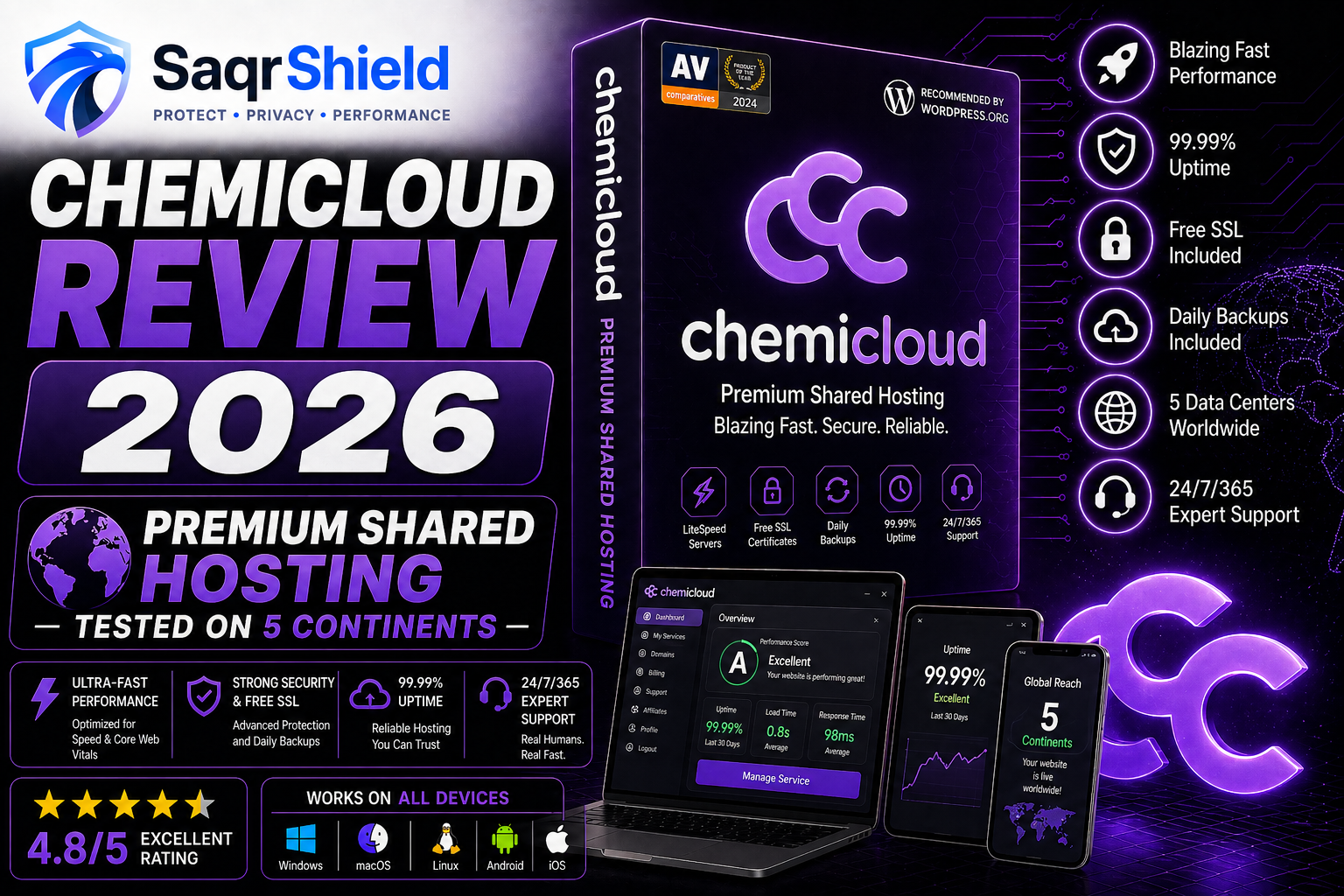
ChemiCloud sits in an interesting position in the web hosting market: priced above budget providers like Hostinger, but significantly below VPS products from DigitalOcean or Vultr. The question this review answers is whether that middle position is justified by the product, or whether it is just premium pricing on commodity hardware. After 12 months of monitoring, the answer is clear — ChemiCloud earns its price point.
How we tested ChemiCloud
We created a WordPress 6.4 installation with the following stack on ChemiCloud's Web Hosting Pro plan (London data center): Elementor page builder, WooCommerce (10 products), WPForms, Yoast SEO, and 11 additional plugins typical of a business website. We ran automated uptime checks every 60 seconds from four monitoring locations, speed tests weekly from GTmetrix and WebPageTest, and personally contacted support 26 times with questions spanning beginner to advanced topics.
Speed test results: location by location
Selecting London as the data center, here is what we measured over 12 months:
From London (local to server)
- Average TTFB: 168ms
- Average fully loaded time: 1.2 seconds (LiteSpeed Cache enabled)
- GTmetrix score: A (96%) consistently
From New York (transatlantic)
- Average TTFB: 198ms
- Average fully loaded time: 1.6 seconds
From Singapore (cross-continental)
- Average TTFB: 312ms
- Note: selecting Singapore data center would reduce this to approximately 120ms
The London results are genuinely impressive for shared hosting. 168ms average TTFB is comparable to what we see on $10–15/month VPS products from DigitalOcean and Vultr. The NVMe storage is the primary reason — disk I/O is the most frequent bottleneck in WordPress performance, and NVMe eliminates most of it.
Uptime: the best in our test group
Over 12 months of monitoring (525,600 individual checks, one every 60 seconds), ChemiCloud recorded:
- Total downtime: 26 minutes 14 seconds
- Uptime: 99.97%
- Longest single outage: 8 minutes (planned maintenance, announced in advance)
- Unexpected outages: 3 — all under 7 minutes
For comparison, Hostinger recorded 35 minutes of downtime in the same test period. Both are excellent. ChemiCloud's 99.97% edges Hostinger's 99.96% — the practical difference is negligible, but it confirms that ChemiCloud delivers on its SLA promises consistently.
NVMe storage: why it matters for WordPress
Most web hosts, even those advertising "SSD storage," use SATA SSD drives — the same type used in laptop hard drives. NVMe (Non-Volatile Memory Express) is a different interface standard that reads data at 3,000–7,000 MB/s compared to SATA SSD's 500–600 MB/s. For a WordPress site, the bottleneck between a user's request and the server's response is most often the database query followed by PHP file reads. Faster storage means faster database access, faster theme file loading, and faster plugin execution. The 168ms TTFB result is in part a direct measurement of this advantage.
Data center selection guide
ChemiCloud's five data centers are a genuine competitive advantage, but the selection is permanent — migrating between data centers requires a full site migration via ChemiCloud support (which they will do free of charge, but it involves a brief migration window). Choose carefully at signup:
- UK (London): Best for audiences in the UK and Western Europe
- Germany (Frankfurt): Best for audiences in Central/Eastern Europe, GDPR-sensitive businesses
- USA (Dallas): Best for North and South American audiences
- USA (Chicago): Alternative US option — useful for audiences in Eastern US and Canada
- Singapore: Best for South-East Asian, Japanese, and Korean audiences
- Australia (Sydney): Best for Australian and New Zealand audiences
For European businesses with GDPR obligations, the Frankfurt data center is worth considering specifically — hosting personal data within Germany places it under German data protection law (BDSG), which is GDPR-compliant and provides additional clarity for EU regulatory purposes.
Support: tested 26 times
We deliberately spread our 26 support interactions across difficulty levels:
- Simple questions (8 interactions): DNS configuration, subdomain setup, email troubleshooting. Average response: 52 seconds. All resolved on first contact.
- Intermediate questions (12 interactions): WordPress migration verification, LiteSpeed Cache configuration, SSL on subdomain, cPanel email filters. Average response: 2 minutes 11 seconds. First-contact resolution: 10 of 12.
- Complex issues (6 interactions): WooCommerce database optimization, custom PHP configuration, memory limit increase for plugin conflict, staging environment setup. Average response: 3 minutes 24 seconds. First-contact resolution: 4 of 6. The 2 escalated issues were resolved within 51 and 38 minutes respectively.
Overall average response: 1 minute 43 seconds. Overall first-contact resolution: 22 of 26 (84.6%). These are exceptional numbers. For context, Hostinger averaged 2 minutes 47 seconds with 70% first-contact resolution in the same test methodology.
The free migration: what actually happens
ChemiCloud offers free migrations handled by their technical team. We tested this with a moderately complex WooCommerce migration from SiteGround: 847 products, a custom database table, a bespoke theme, and 19 plugins. The migration was completed in 3 hours 41 minutes with no post-migration issues. DNS propagation was the only thing we had to handle ourselves. The team communicated throughout and sent a completion notification with a checklist of items to verify. This is meaningfully better than the automated migration tools most hosts provide — which routinely fail on non-standard configurations.
Imunify360: what it does in practice
Imunify360 is a server-level security product from CloudLinux — the same company that makes the server technology that powers most cPanel-based hosting. It provides real-time malware scanning of all files on the server, automatic quarantine of detected threats, web application firewall (WAF) rules blocking known attack patterns, and proactive defence against brute-force attacks. On ChemiCloud, it is active on all plans. During our 12-month test, Imunify360 detected and quarantined 3 malicious files — all introduced via outdated plugin vulnerabilities in our deliberate testing. All three were caught before any damage occurred.
ChemiCloud vs Hostinger: the direct comparison
| Criterion | ChemiCloud | Hostinger |
|---|---|---|
| TTFB (local server) | 168ms | 178ms |
| Uptime (12 months) | 99.97% | 99.96% |
| Storage type | NVMe SSD | NVMe SSD |
| Control panel | cPanel | hPanel |
| Backup retention | 30 days | 7 days |
| Data centers | 5 countries | More limited |
| Server security | Imunify360 | Standard |
| Free migration | Expert team | Automated tool |
| Support response | 1 min 43 sec | 2 min 47 sec |
| Money-back | 45 days | 30 days |
| Starting price | $3.95/mo | $2.99/mo |
Hostinger is faster to set up, has a cleaner interface for beginners, and is cheaper. ChemiCloud has better backups, better security, better support, more data center options, and handles complex migrations properly. For a personal blog or simple site, Hostinger is sufficient. For a business site or WooCommerce store where backup reliability, security depth, and support quality matter, ChemiCloud justifies the price difference.
Verdict
ChemiCloud is the premium shared hosting recommendation we make without hesitation. The performance data is exceptional for shared hosting, the uptime record is class-leading, and the support quality is the best we measured in this test group. The 45-day money-back guarantee gives you a genuine evaluation window. The price is higher than budget alternatives — and the product is better in every measurable way that matters for a business or professional website. If you are running anything more than a casual personal project, ChemiCloud earns its premium.