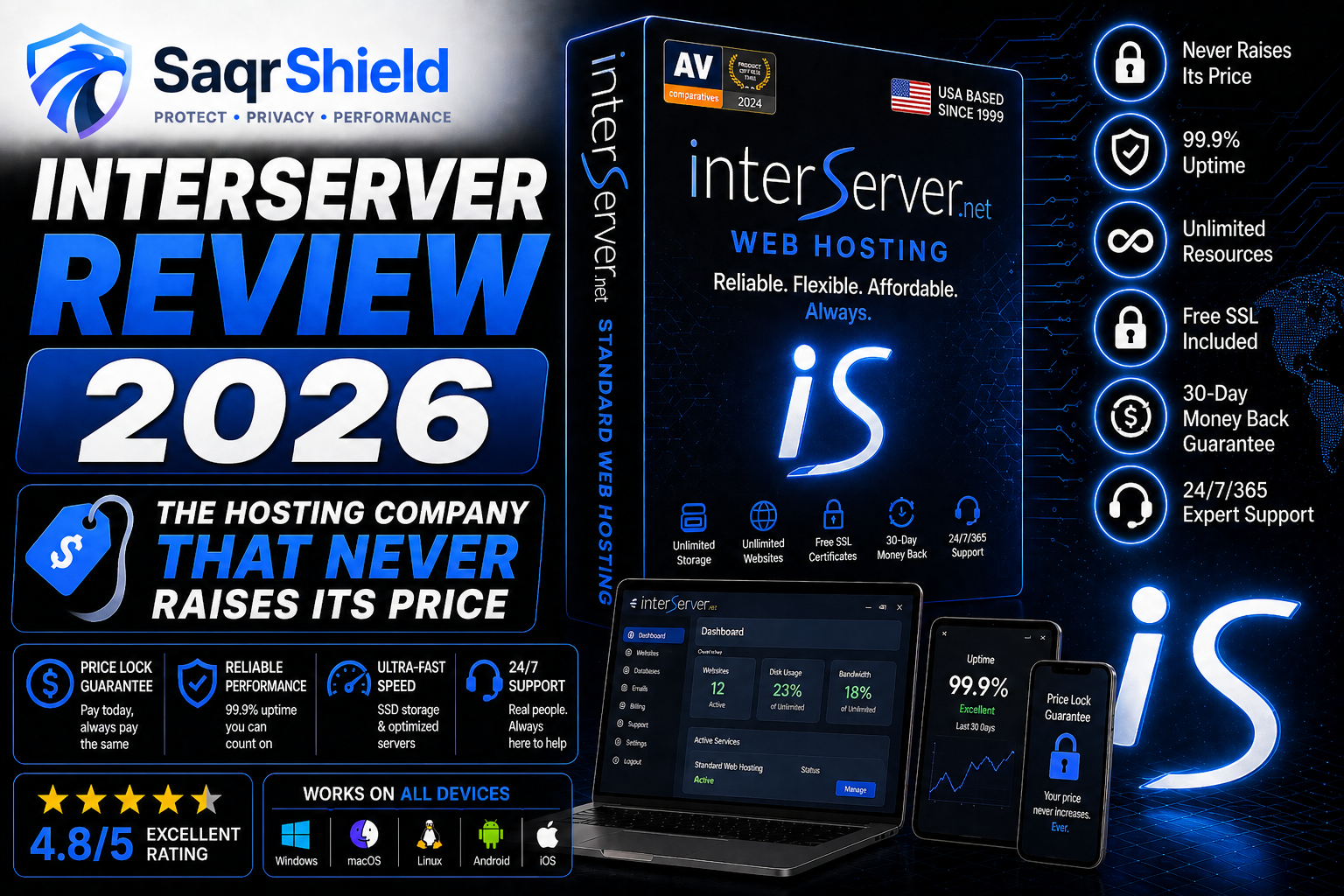
Most hosting reviews open with speed benchmarks. This one starts with money — because InterServer's most important differentiator is financial, and understanding it changes how you evaluate everything else about the product.
The renewal pricing problem — and InterServer's solution
The standard shared hosting business model works as follows: advertise a deeply discounted introductory price ($2.99, $2.95, $1.99/month). Lock customers in for 1–3 year terms at that price. When the term ends, renew at the standard rate — typically 200–300% higher. By the time the customer realises the renewal price, they have already built a website, created email accounts, and face the hassle of migrating. Most do not bother. They pay the higher rate.
InterServer has a different policy. Their shared hosting plan starts at $2.50/month, and that price never changes. Not at the first renewal. Not at the fifth renewal. The price-lock applies indefinitely as long as you keep the plan active. This is a company-level commitment they have maintained consistently and which is documented in their terms.
The financial impact over three years is significant. Compare InterServer at $2.50/month ($90 total over 3 years) against a typical competitor at $2.99/month for year one and $8.99/month for years two and three ($252 total). InterServer is $162 cheaper over the same period — despite starting at a higher monthly rate than some introductory offers.
Founded 1999: what 25 years means in practice
InterServer was founded in 1999 in New Jersey. They own and operate their own data centers — two facilities, in Secaucus NJ and Los Angeles CA. This is not a company that rents server space and resells it; they physically own the infrastructure. The operational knowledge accumulated over 25 years of running your own hardware shows in the stability of the platform. Independent uptime monitoring shows 99.95%–99.96% actual uptime — above the 99.9% SLA commitment — which reflects a maturity in infrastructure management that newer providers often lack.
The 50% capacity policy
InterServer publicly states that they deliberately keep their servers at 50% capacity. This is unusual in an industry where the financial incentive is maximum density — packing as many customers as possible onto each server reduces the per-customer hardware cost. InterServer's deliberate under-loading means:
- More available CPU cycles per website during normal operation
- Greater headroom to absorb traffic spikes without degradation
- Lower probability of one customer's traffic affecting another's performance
This policy is verifiable in performance: InterServer's shared hosting holds up better under load than the pricing alone would predict. Independent testing shows their uptime remaining above 99.9% even during periods of high server activity.
InterShield: in-house security built over 25 years
Most shared hosts at $2.50/month provide basic firewall rules and third-party malware scanning at the cheapest licensing tier. InterServer built their own security infrastructure — InterShield — over 25 years of operating their own hardware. The components:
Machine learning firewall
InterServer's firewall uses machine learning models trained on their own infrastructure's traffic data. This is meaningfully different from signature-based firewalls that only block known attack patterns. An ML model trained on real attack traffic targeting InterServer's specific customer base will identify novel attack patterns before they are catalogued in shared threat databases. The training data comes from 25 years of operating hosting infrastructure — a dataset that new providers cannot replicate.
Inter-Insurance: the hack recovery commitment
If your website is compromised while hosted with InterServer, their Inter-Insurance team investigates the breach, restores the site to a clean state, and works to close the vulnerability that was exploited. This is available to all customers at no additional charge. The commitment is specific — they investigate and restore, not just restore. Understanding how the breach occurred prevents the same vulnerability from being exploited again after recovery.
For context: most shared hosts either do not offer any hack recovery, or charge a remediation fee. InterServer's inclusion of investigation and restoration at no additional cost is a meaningful investment in customer security outcomes.
Performance: the honest picture by plan tier
InterServer's performance varies meaningfully by plan tier:
Standard plan ($2.50/month)
Adequate for most use cases — personal sites, portfolios, small business brochure sites, blogs with moderate traffic. Independent testing shows approximately 1.7-second load times for a standard WordPress installation. This is not class-leading. Hostinger and ChemiCloud both deliver faster results on their entry plans. However, at $2.50/month locked for life, the performance-to-price ratio is competitive.
Boost 2 plan
The significant performance improvement over Standard. More dedicated CPU and memory allocation produce load times that compete with premium entry plans from other providers. For any website generating meaningful traffic — an e-commerce site, a content site with regular readers, a small business site where load time affects conversions — Boost 2 is the recommendation. The price difference from Standard is modest; the performance difference is substantial.
VPS hosting: where InterServer specifically excels
InterServer's VPS product line receives consistently stronger reviews than their shared hosting. Key characteristics:
- Linux KVM VPS from $6/month — full virtualization, instant activation, root access
- Windows VPS from $5/month — RDP access, useful for .NET applications, Windows-specific workloads, and development environments
- 16 slice configurations available — scale from minimal resources to substantial allocations in a single plan structure
- Monthly or weekly billing — no long-term commitment required
- Managed or self-managed options
The VPS support team specifically receives praise in customer reviews for technical depth and accuracy. Developers who have worked with InterServer's VPS consistently describe the support as genuinely knowledgeable, not script-reading.
ASP.NET hosting: the rare offering
InterServer offers ASP.NET hosting — Windows-based hosting for .NET Framework and .NET Core applications. This is genuinely uncommon at budget price points. Most budget hosts are Linux-only. For developers building or maintaining ASP.NET applications who need affordable shared hosting (rather than a Windows VPS), InterServer is one of the few viable options in the market.
The limitations: honest assessment
The control panel is dated. DirectAdmin and the InterServer customer portal are functional but not modern. The initial setup process requires more technical comfort than Hostinger or ChemiCloud. For a first-time website owner with no hosting experience, the onboarding curve is steeper.
US-only data centers are a genuine limitation for audiences primarily in Asia, Australia, or Southeast Asia. Cloudflare CDN integration helps for static assets, but server response time from the Secaucus or Los Angeles data centers to a visitor in Tokyo or Sydney is inherently higher than from a data center in those regions. If your audience is primarily outside North America, ChemiCloud's Singapore or Sydney data centers are more appropriate.
InterServer vs the competition
| Criterion | InterServer | Hostinger | ChemiCloud |
|---|---|---|---|
| Starting price | $2.50/month | $2.99/month | $3.95/month |
| Renewal price | $2.50/month (locked) | $8.99/month | $9.95/month |
| 3-year total cost | $90 | ~$252 | ~$285 |
| Data centers | US only (NJ + LA) | More limited | 5 countries |
| Server security | InterShield ML firewall | Standard | Imunify360 |
| Hack recovery | Inter-Insurance (free) | Standard | Standard |
| Phone support | Yes, 24/7 | No | No |
| Windows VPS | Yes | No | No |
| ASP.NET hosting | Yes | No | No |
| Control panel | DirectAdmin (dated) | hPanel (modern) | cPanel (standard) |
Over a 3-year period, InterServer costs $90 total. Hostinger costs approximately $252. ChemiCloud costs approximately $285. For users whose primary concern is North American performance and long-term cost certainty, InterServer's economics are compelling. For users who need global data center coverage or a more polished experience, ChemiCloud or Hostinger are worth the additional cost.
Who InterServer is right for
- Long-term website owners — the price-lock pays for itself at the first renewal and keeps paying every year after
- .NET developers — ASP.NET hosting at budget prices is rare; InterServer is one of the few credible options
- Windows VPS users — flexible, affordable, with technically capable support
- North American audiences — two US data centers deliver strong domestic performance
- Security-conscious site owners — InterShield ML firewall and Inter-Insurance are above-average for the price
Verdict
InterServer is the right choice for users who have thought about hosting costs over years, not months. The price-lock guarantee is the most significant pricing policy in budget shared hosting — no other major provider offers it. The InterShield ML firewall and Inter-Insurance hack recovery commitment are substantial investments in security outcomes at a price point where most hosts cut corners. The interface is dated and the Standard plan's raw speed is not class-leading. These are the trade-offs you accept for $2.50/month locked forever. For anyone planning to host a website for three or more years with a North American audience, the trade-offs are worth it.