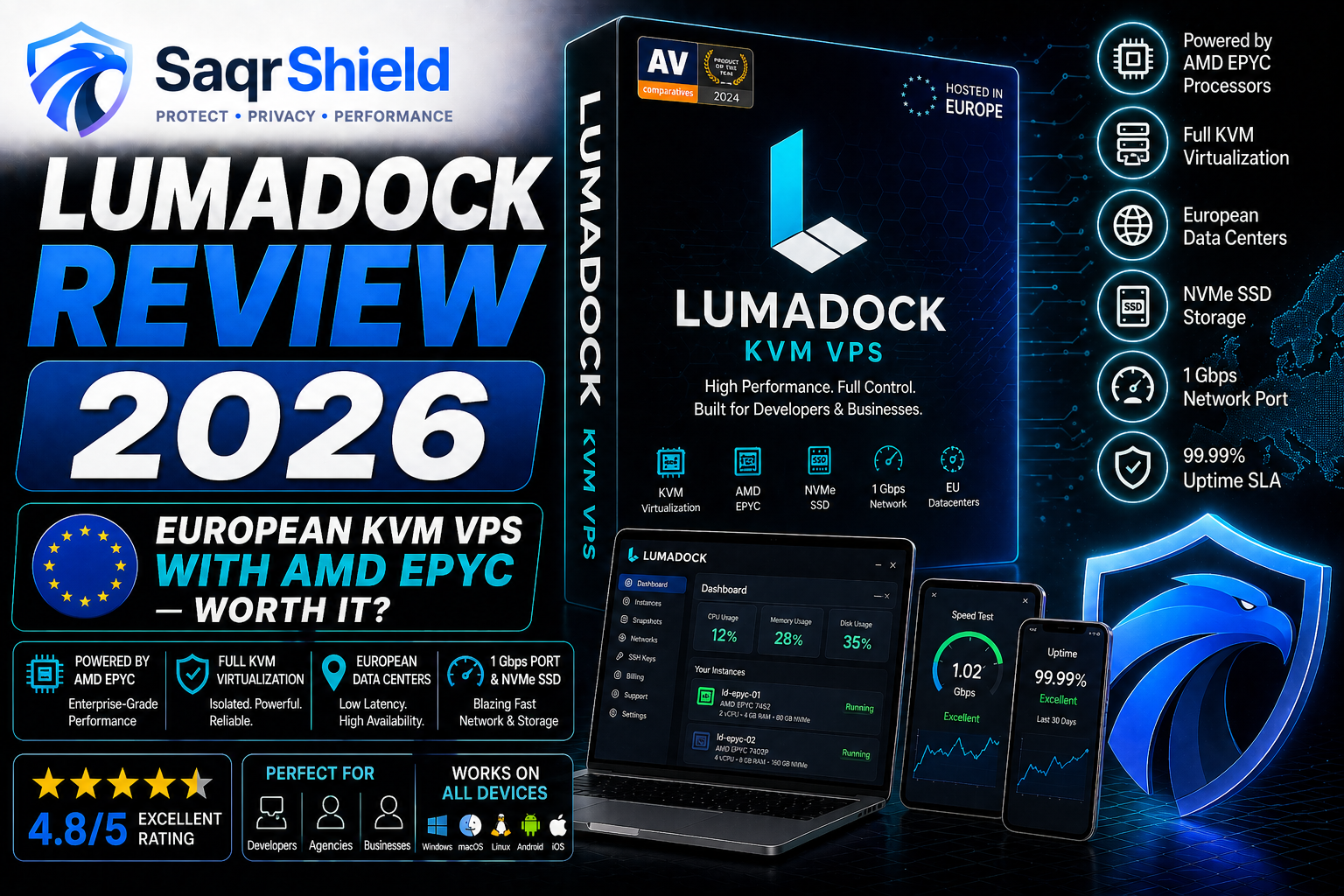
The VPS market has a problem: most providers are either cheap and unreliable, or reliable and expensive. LumaDock occupies the honest middle ground — a European company with 16 years of infrastructure experience, real hardware ownership, and pricing that does not require you to commit to a 3-year contract to get a reasonable rate. This review covers what the product actually delivers, where it sits against alternatives like Hetzner and Vultr, and who should choose it.
Background: who is LumaDock?
LumaDock is the consumer brand of LifeinCloud LTD, a company registered in England and Wales (London W1S 1HN). The infrastructure roots go back to 2009, when the parent company began as a managed services provider. Over 16 years, it evolved into a cloud VPS platform operating owned hardware in Tier III+ facilities. This matters because many smaller VPS providers are actually resellers — they rent server space from larger providers and mark it up. LumaDock owns and operates its own hardware, which gives it direct control over performance, security configuration, and maintenance windows.
Data centers are in nine locations: London, Frankfurt, Paris, Amsterdam, Warsaw, Bucharest, Helsinki, Madrid, and New York. All are Tier III+ facilities — meaning redundant power, redundant cooling, and redundant network connections. No single hardware failure can bring the facility offline.
VPS product lines
LumaDock offers three distinct VPS products:
Standard KVM VPS (from $1.99/month)
The main product line, suitable for web applications, databases, APIs, development environments, and general-purpose server workloads. KVM full virtualization provides complete OS isolation. Configurations range from 1 vCPU / 1GB RAM at entry level to multi-vCPU, high-RAM instances for production workloads. AMD EPYC processors and NVMe SSD on all plans.
GPU VPS
For teams needing GPU access for machine learning inference, model training, rendering, or scientific computing without the cost of bare-metal GPU hardware or the pricing of AWS/Azure GPU instances. LumaDock's GPU VPS provides access to modern GPU hardware at a fraction of major cloud provider pricing, with the same KVM isolation and network security as the standard VPS product.
Storage VPS (from $4.49/month)
High-capacity HDD-based VPS instances for use cases where raw storage volume matters more than peak I/O performance: backup repositories, media storage, log archiving, and large file serving. AMD EPYC CPUs maintain low latency for access operations even on HDD-based storage.
Why KVM matters (and why not all VPS is equal)
Not all VPS virtualization is the same. The two common technologies are KVM and OpenVZ (or LXC containers):
- OpenVZ/LXC: Containers share the host kernel. Cheaper to operate, but you cannot run a custom kernel, Docker has limitations, and a kernel vulnerability on the host affects all containers. Most budget VPS providers use this.
- KVM: Full hardware virtualization. Each VPS has its own kernel, its own memory allocation, and complete OS isolation. You can run any OS, any kernel version, Docker, WireGuard, or any software that requires low-level system access. A vulnerability in one VPS cannot affect another at the hypervisor level.
LumaDock uses KVM exclusively. This is the correct choice for production workloads, security-sensitive applications, and any developer who needs genuine OS-level control.
AMD EPYC: why it matters for VPS performance
AMD EPYC is a server processor architecture specifically designed for data center use. Key characteristics relevant to VPS performance:
- High core count: EPYC chips have 32–128 cores per socket, meaning many VPS instances can run on a single host with less resource contention than Intel Xeon-based systems at equivalent core counts
- Large memory bandwidth: EPYC's memory architecture supports higher aggregate bandwidth than consumer-grade Xeon equivalents, which reduces memory bottlenecks in database and in-memory cache workloads
- NUMA architecture: Modern EPYC supports Non-Uniform Memory Access, which KVM hypervisors can expose to VPS instances for optimal memory locality
- Security features: AMD Secure Encrypted Virtualization (SEV) encrypts VPS memory at the hardware level, preventing the hypervisor from reading VPS memory contents — relevant for sensitive workloads
Security architecture in detail
LumaDock includes security features that many providers charge extra for:
Always-on DDoS protection: Network-level DDoS mitigation is active at all data centers, filtering malicious traffic at the edge before it reaches the physical server. This protects against volumetric attacks (bandwidth flooding), protocol attacks (SYN floods, ICMP floods), and application-layer attacks on known service ports.
Firewall management: The control panel provides an intuitive firewall interface — define ingress/egress rules, open specific ports, block IP ranges — without needing to configure iptables or nftables directly. This is particularly useful for developers who need granular traffic control without Linux firewall expertise.
Private networking: Optional VLAN-based private networking lets you connect multiple VPS instances over an internal network not exposed to the public internet. This is the correct architecture for separating application servers from database servers — the database accepts connections only from the application server's private IP, never from the public internet.
GDPR compliance: As a UK/EU company operating EU data centers, LumaDock is subject to GDPR. For European businesses with data residency requirements, this means you can host personal data on LumaDock infrastructure in Frankfurt, Amsterdam, or other EU locations with a clear regulatory framework.
LumaDock vs Hetzner
Hetzner is the benchmark for European budget VPS hosting — exceptional hardware value, German data centers, straightforward pricing. How does LumaDock compare?
| Criterion | LumaDock | Hetzner |
|---|---|---|
| Data center locations | 9 (EU + US) | 3 (Germany, Finland, USA) |
| Processor | AMD EPYC | AMD EPYC / Intel |
| Storage | NVMe SSD | NVMe SSD |
| GPU VPS | Yes | Limited |
| Free migration | Yes, engineer-assisted | No |
| DDoS protection | Always-on, all locations | Basic, limited |
| Support quality | Engineers, 24/7 | Good but slower |
| Entry price | $1.99/month | €3.29/month |
| Minimum term | Monthly | Monthly |
Hetzner has an edge in raw price-per-CPU-core for mid-range instances and a stronger reputation in the developer community based on years of consistent performance. LumaDock has more data center locations, better DDoS protection, engineer-assisted free migrations, and GPU VPS options. For most European deployments, both are strong choices — LumaDock is preferable when you need non-German/Finnish EU locations, GPU access, or a migration service.
Use cases LumaDock is specifically good for
- WordPress and web application hosting: Root access + Docker + NVMe means you can run an optimised LEMP stack with OPcache, Redis, and custom PHP configuration that shared hosting cannot deliver
- API and backend services: Low-latency NVMe + EPYC makes LumaDock suitable for REST APIs, GraphQL services, and real-time backends where response time matters
- Database servers: Isolated KVM + NVMe + private networking — run PostgreSQL or MySQL in a secure, isolated environment accessible only from your application server's private IP
- CI/CD and development environments: Instant provisioning + no minimum term + GPU VPS makes it practical to spin up build environments, run test suites, and tear them down when finished
- VPN servers: WireGuard and OpenVPN are natively supported; install, configure, and run a private VPN server in under 15 minutes
- Game servers: Low-latency AMD EPYC + 1 Gbps network handles Minecraft, CS2, or other game server workloads; dedicated IPv4 included
- AI inference: GPU VPS provides affordable access to GPU compute for running local LLMs, image generation models, or custom inference endpoints
Pricing transparency: no surprises
LumaDock's pricing page lists the full cost of each plan with no hidden additions. There are no charges for:
- DDoS protection (included)
- Firewall management (included)
- IPv4 address (included with each VPS)
- VPS control panel (included)
- Migration assistance (free)
- Setup or activation (free)
Bandwidth allowances are generous and overages are charged at a predictable per-GB rate that is stated clearly before you exceed the limit. Monthly billing with no minimum term means your only commitment is the current billing period — a meaningful advantage over shared hosting providers that require 1–4 year commitments for promotional pricing.
Verdict
LumaDock delivers what a VPS provider should deliver: real hardware (AMD EPYC + NVMe), genuine KVM isolation, nine data center locations including all major European markets, always-on DDoS protection, free engineer-assisted migrations, transparent pricing without hidden fees, and support from people who understand infrastructure. The GPU VPS product is a compelling addition for teams with AI workloads. The entry price of $1.99/month for a genuine KVM VPS with NVMe and DDoS protection represents strong value. For developers and businesses who need server control, GDPR compliance, and reliable European infrastructure, LumaDock is one of the most complete options currently available in its price range.